Best Free Crypto Cashback Cards in the US Comparison Table
This table compares each card’s advertised cashback rate, the fees and conditions that can reduce it, and the effective return at $1,000 of spending. Because our comparison focuses on domestic U.S. spending, cross-border payment fees do not affect the results.
To narrow down our scope, we focus specifically on cards at their free entry-level tiers. We also consider fees that could eat into the card’s cashback, state availability, ease of use, additional features, what currency/token the cashback is paid in, and what redemption process the cashback actually involves.
| Card | Gross cashback | Fees and conditions | Effective cashback at $1,000 |
|---|
 EtherFi EtherFi | 3% on first $2,000 | Free Core membership; cashback paid in ETHFI; 7-day lock; $5 minimum claimable balance; unavailable in 17 US states | 3.00% ($30.00) |
 Lava Lava | 3% for US users | No annual fee or transaction fee; 0.001 BTC threshold for redemption; cashback in BTC | 3.00% ($30.00) |
 KAST KAST | 1.5% on first $2,000 | $0 annual fee; 0% fee on USD card spending | 1.50% ($15.00) |
  Plasma One Plasma One | 2% on first $500, then 0.1% | Free tier; rewards paid in XPL | 1.05% ($10.50) |
 Wirex One (honorable mention) Wirex One (honorable mention) | 0.5% on Base tier | Cashback paid in USD; $25 redemption cap; Base tier includes virtual card only | 0.50% ($5.00) |
A Closer Look at the Top Crypto Cashback Cards
The cards below offer the strongest ongoing cashback rates out of dozens of crypto cards tested, but each suits a slightly different type of user.
Best Overall Cashback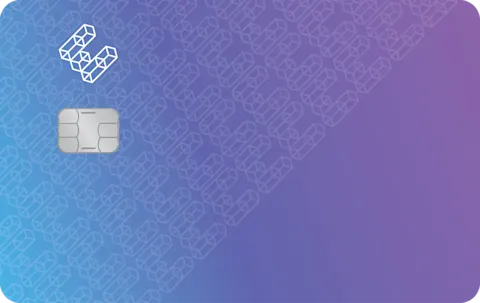
- 3% cashback on the first $2,000 of monthly spending, paid in ETHFI
- $30 in gross rewards at $1,000 of monthly spend
- Rewards are locked for 7 days and require $5 to claim
ether.fi came first with one of the highest cashback rates for eligible users. Core, ether.fi’s free entry-level tier, earns 3% on the first $2,000 of monthly spending, 1% from $2,001 to $3,000, and 0.5% thereafter. At $1,000 per month, spending remains within the first band, producing $30 in gross rewards and a 3% cashback rate. Cashback is now paid in ETHFI. Once a purchase clears, the dollar-denominated reward is converted into ETHFI at the current price and locked for seven days. Users can claim their ETHFI once their claimable cashback balance reaches at least $5.
Apart from its high cashback, ether.fi also stands out with its features, including:
- Affiliate programme – ether.fi offers a four-tier affiliate programme, with rewards increasing based on qualifying referrals. Benefits can include cashback on referral spending, card commissions and revenue share on yield generated by referred users.
- Staking options – ether.fi supports several staking assets, like EUR, USD (RWAs), ETH, and BTC with yields displayed using a 14-day trailing APY.
The main drawbacks are availability and the way cashback is now distributed. The card remains unavailability in 17 US states, while rewards are paid in ETHFI rather than a stablecoin, locked for seven days and subject to a $5 minimum claimable balance. This also means the dollar value of a reward can change between conversion and the point at which it becomes claimable.
Best Bitcoin Cashback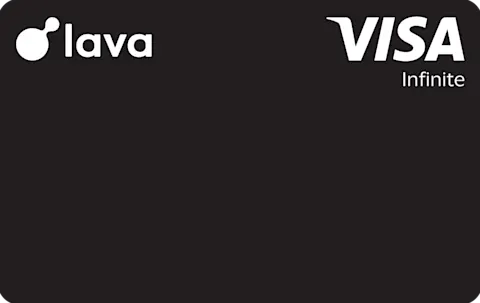
- 3% back in Bitcoin for US users on eligible purchases
- Up to 5% with partner merchants including Amazon and Apple
- Rewards redeemable from 0.001 BTC
Lava remains the runner-up despite matching ether.fi’s 3% headline rate. Both cards now place conditions on accessing rewards: Lava requires users to accumulate at least 0.001 BTC before redeeming, while ether.fi requires at least $5 of claimable cashback and applies a seven-day lock. We placed ether.fi slightly ahead because its $5 claim threshold is easier for most users to reach, although its ETHFI-denominated rewards introduce additional price volatility.
The card ranks second in our testing, giving US users 3% back in Bitcoin on everyday eligible purchases, producing approximately $30 in rewards on $1,000 of monthly spending. During Lava’s launch promotion, selected merchants including Amazon, Apple and Netflix had 5% Bitcoin cashback. Cashback is paid in BTC.
Beyond its cashback rate, Lava had one of the most intuitive interfaces in our testing. Its Bitcoin line of credit offers funds in a pinch with 7.5% annual interest for loans under $100,000. Lava’s default free card is also Visa Infinite, meaning that a user also gets a range of benefits like travel perks (concierge, rental, hotels, priority passes to airport lounges, etc.) and emergency support services.
The main limitation is the redemption threshold. Users must accumulate at least 0.001 BTC cashback before redeeming their rewards. Since the dollar value of that threshold changes with Bitcoin’s price, lighter spenders may need to wait several months. Even so, Lava remains one of the strongest options for users who specifically want cashback paid in Bitcoin.
Best Flat-Rate Cashback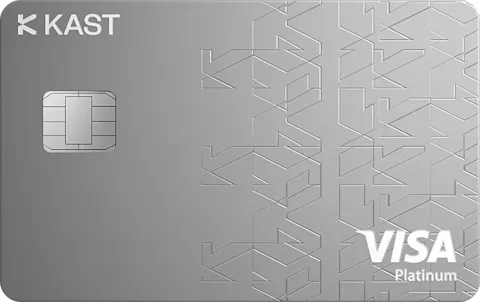
- 1.5% cashback on the first $2,000 of monthly spending, paid in USD
- Up to $100 in milestone bonuses on your first $1,000
- Visa Platinum perks on the free Standard tier
KAST has been placed third thanks to its free Standard tier that offers a solid 1.5% cashback on up to $2,000 of monthly spending. At $1,000 monthly spending, a user would earn approximately $15, while the maximum ongoing cashback available through the free tier is $30 per month. Cashback is paid in USD.
Not only is KAST’s virtual card free, but it also comes in several designs like the K Card, Bitcoin Standard Card, Solana Card, and the Pengu Card. The default card is a Visa Platinum, meaning it comes with its own set of perks, like rebates on specific merchants and fast track at airports.
The app includes referral rewards of up to $1,250, as well as KAST Points earned through card activity, however earning points isn't included in KAST’s Standard tier.
KAST offers two vaults that allow users to earn interest on their funds: the USD Prime Vault and the Gauntlet Alpha Vault. The USD Prime Vault offers 3.3% APY and is backed 1:1 by short-term U.S. Treasury Bill reserves. It is secured by Privy and operates on the Solana network. The Gauntlet Alpha Vault offers up to 7% APY by putting users’ USD to work across decentralized finance (DeFi) protocols. It is also secured by Privy and operates on the Base network.
KAST also offers spending-task rewards, which we cover later as one of the best crypto card welcome bonuses. The main drawback is its lower ongoing cashback rate. At 1.5%, KAST earns only $15 on $1,000 of monthly spending, half the $30 offered by ether.fi and Lava at the same spending level. Its highest rate is also limited to the first $2,000 spent each month.
Best Under $500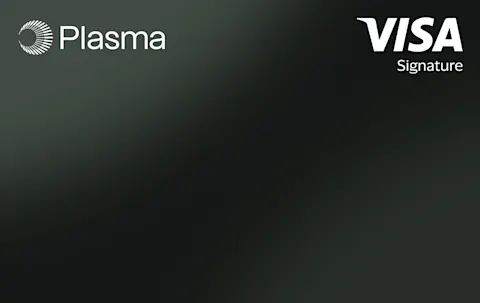
- 2% cashback on the first $500 of monthly spending
- ≈1.05% blended cashback at $1,000, rewards paid in XPL
- 3.85% APY on balances via Earn, with no lockup
Plasma One ranks fourth, with a strong cashback rate for lighter spenders. Its free Lite tier offers 2% cashback on the first $500 of monthly spending and 0.1% thereafter. Spending $500 produces $10 in rewards, preserving the full 2% rate. At $1,000, users earn $10 on the first $500 and another $0.50 on the remaining $500, producing approximately $10.50 in total rewards, or 1.05% blended cashback. Users can manually cash out their XPL rewards for USD.
Plasma One also stood out for its modern interface and built-in Google Wallet and Apple Pay integration, which lets users add the card automatically instead of manually entering the card number and other details. Plasma’s Earn feature offers 3.85% APY with no lockup, allowing users to earn yield while keeping their funds accessible.
The main drawback is how sharply the cashback rate falls after the first $500 of monthly spending. This makes Plasma One considerably more attractive for users spending $500 or less than for those consistently spending closer to $1,000.
Best Tiered Cashback
- 0.5% cashback on the free Base tier, paid in USD
- $5 in rewards at $1,000 of monthly spending
- Higher tiers increase cashback to as much as 8%
Wirex One earns an honorable mention, with its free Base tier offering 0.5% cashback paid in USD. At $1,000 of monthly spending, this produces approximately $5 in rewards. Wirex becomes more competitive at its higher tiers, with cashback increasing to 1% on Premium, 3% on Elite, 5% on Private, and up to 8% on Bespoke. However, these tiers require users to meet higher balance requirements, so we use the Base rate for our free-tier comparison.
Beyond cashback, Base users get up to $500 of fee-free exchange per month, $100 of fee-free ATM withdrawals, and access to Wirex Earn, with rates reaching up to 6.75% on selected crypto and stablecoin balances. Wirex also supports bank, card, and on-chain stablecoin deposits, as well as Apple Pay and Google Pay. During our testing, onboarding took around 10 minutes and the process was smooth.
The main drawback is the relatively low Base cashback rate. At 0.5%, Wirex returns only $5 on $1,000 of monthly spending, placing it below Plasma One, KAST, ether.fi, and Lava in our comparison. The Base tier is also virtual-card only, with physical cards reserved for higher Wirex tiers.
Although we’ve already established the top cashback rates for $1,000 in monthly spending, there are a few cards worth spotlighting for their temporary welcome offers or sign-up bonuses. Here’s a table highlighting these cards:
| Card | Promotional offer | Main conditions | Estimated value at $1,000 |
|---|
| KAST | Up to $20 after the first $100; up to $30 after another $500; up to $50 for $1,000; further bonuses available at higher spending levels | Offer eligibility may vary by country; check the KAST Rewards section for the current milestones available to your account. | Up to $100 in milestone bonuses \+ $15 regular cashback ≈ $115 at $1,000 spend |
 Oobit Oobit | 10% on eligible OOB-funded purchases; 5% on up to $200 of eligible USDT/USDC spending | Offers unlock at Level 2 after $250 of qualifying spend; $0.25 or 1% transaction fee, whichever is higher; rewards restricted to Oobit Tap to Pay | Up to $65 gross promotional rewards, or ≈$55 after a 1% fee on $1,000 total spend, before OOB acquisition costs |
| Lava | 5% Bitcoin cashback with merchant partners, including Amazon, Apple, and Netflix at launch | Applies only to participating merchants; 0.001 BTC threshold | Up to $50, compared with $30 at Lava’s standard US rate |
KAST: Best Overall Welcome Bonus
KAST’s Cash Bonus Rewards program offers additional rewards for hitting spending milestones. At the time of writing, users can earn $20 after spending $100, $30 after $500, $50 after $1,000, and $150 after $5,000. Assuming these rewards are cumulative, a new user spending $1,000 could earn an additional $100 in bonus rewards.
Combined with the approximately $15 earned through KAST’s regular 1.5% cashback rate, that brings total rewards on the first $1,000 of spending to around $115, equivalent to an effective return of 11.5% during the promotional period.
This makes KAST particularly attractive for new users who expect to spend enough to reach several bonus milestones soon after signing up.
Oobit offers a very high cashback rate of up to 10% on purchases funded with OOB tokens, with rewards paid in USDT. However, users need to meet several conditions to qualify for the highest rate. They must reach Level 2 or above, which requires $250 in qualifying cumulative spend. Qualifying purchases must be at least $1. The 10% OOB cashback reward applies to up to $10,000 of OOB-funded spending.
For existing Oobit users who have already reached Level 2 and are willing to hold and spend OOB tokens, the offer can provide a very attractive cashback incentive.
Lava offers up to 5% cashback with selected Bitcoin-aligned merchants, including several major consumer, developer, and AI brands:
- Amazon, Apple, Netflix
- Vercel, Supabase, Cursor
- OpenAI, Anthropic, xAI, Cognition, Perplexity
Combined with its already strong 3% cashback on everyday purchases, Lava makes for an appealing beginner-friendly card for users who specifically want to earn rewards in Bitcoin.
How Crypto Cashback Is Taxed in the US
According to the IRS, digital assets are treated as property for federal tax purposes. Selling, exchanging, or spending crypto can therefore trigger a capital gain or loss based on the difference between the asset’s cost basis and its value when disposed of.
Purchase-based crypto cashback is generally treated as a rebate rather than taxable income. The IRS has previously treated purchase-linked credit card rebates as adjustments to the purchase price rather than gross income, although it has not issued guidance specifically addressing every crypto card cashback structure.
Users should still keep records of their crypto card transactions and any crypto rewards they receive. The IRS recommends tracking information such as the asset, date received, number of units, fair market value in US dollars, and cost basis. If cashback is received in Bitcoin, XPL, or another digital asset and is later sold, exchanged, or spent, that later disposal can create a taxable capital gain or loss.
Sign-up bonuses, referral rewards, staking rewards, and other rewards that are not directly tied to a purchase may receive different tax treatment.
Key Features: What to Look for in a Crypto Card
Not all crypto cards are created equal. Here are the features that matter most when choosing between them.
- Cashback rates and limits. Base cashback ranges from 0.5% to 3% across the cards we track, with boosted tiers reaching as high as 8% for programs like Tria and KAST. But the cap matters just as much as the rate. Some cards limit rewards to as little as $25 per month, while others like Gnosis Pay offer limits above $20,000 per month. We've found that in most cases a card's Base Cashback represents the overall attractiveness of its cashback program.
- Foreign exchange fees. Most crypto cards settle in USDC or USDT, which means transactions are processed in US dollars at the point of sale. For users spending in non-USD currencies, this introduces an FX conversion. Gnosis Pay avoids this for EUR and GBP spending via EURe and GBPe, while ether.fi applies 0% FX to eligible EUR purchases regardless of whether the spending token is USDC or EURC. Beyond native currency support, listed FX fees range from 0% to 2.5% across the cards we track. Ready stands out with 0% FX fees, while most others fall between 0.5% and 2.5%.
- Borrow to spend. Some cards let you spend against your crypto collateral without selling it, effectively taking a stablecoin loan backed by your portfolio. Currently only EtherFi supports this, with Tria expected to add the feature in the near future. This can be a useful way to access liquidity while maintaining exposure to your assets, and has tax benefits in some jurisdictions.
- Payment network and wallet support. Cards are issued on either Visa or Mastercard, with some programs like Bitget Wallet offering both. Apple Pay and Google Pay support is nearly universal across all cards tracked.

