

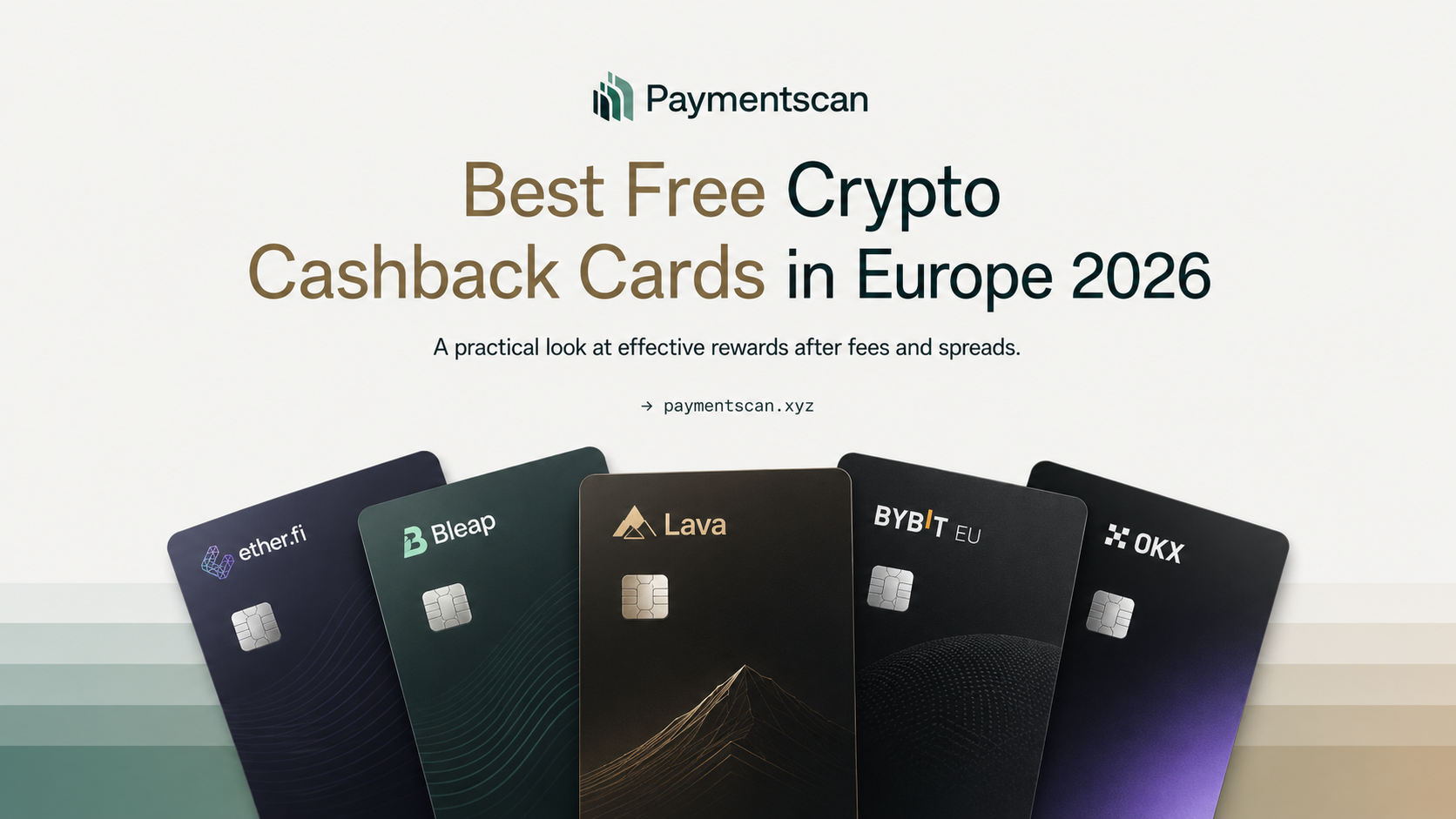
Crypto cards increasingly advertise rewards that rival traditional debit and credit cards, but the highest rates are often tied to paid plans, token holdings, large balances, or narrow spending limits. For European users spending around €1,000 per month, the more useful question is how much cashback remains after those restrictions and transaction costs are included.
Ether.fi offers the highest estimated return when purchases are made entirely in euros, producing approximately 2.6% blended cashback at €1,000 of monthly spending. Its performance was much weaker in our non-euro testing, where an observed spread of approximately 2.04% reduced the estimated return to around 0.56%. Bleap and Lava delivered lower headline rewards but retained approximately 1% cashback across the transactions we tested.
The table is ordered by estimated ongoing cashback on €1,000 of euro-denominated spending. Where relevant, we also show the results from purchases made in PLN, since users in non-euro European countries may experience different conversion costs. Temporary welcome rates, such as Krak’s first-month promotion, are placed below ongoing cashback offers.
| Card | Gross cashback | Fees and spreads | Effective cashback at €1,000 |
|---|---|---|---|
| ether.fi | 3% to €800; 1% from €801 to €1,500 | 0% FX markup on EUR purchases; ≈2.04% observed spread on tested PLN purchases | ≈2.6% on EUR spend; ≈0.56% on tested non-EUR spend |
| Bleap | 1% on up to €3,000 | No observed spread | ≈1% on EUR and tested non-EUR spend |
| Lava | 1% internationally; up to 5% with partners | No observed spread | ≈1% on EUR and tested non-EUR spend |
| Bybit EU | 1%; no monthly cap | 0.9% crypto-conversion fee; 0.5% FX fee on non-EUR purchases | ≈1% with EUR fiat; ≈0.1% with crypto; ≈−0.4% with crypto plus FX |
| OKX | 2% on first €500 | No observed spread; USDG funding required | ≈1% at €1,000 on EUR and tested non-EUR spend |
| Krak | 2% for first 30 days; 0% afterward | No fiat FX markup observed; variable spread when selling crypto | ≈2% for 30 days with fiat; 0% afterward |
The results differ depending on the currency used. Ether.fi leads when spending directly in euros, while Bleap and Lava produced more consistent returns across the non-euro transactions tested. OKX also delivered approximately 1% at €1,000, although its €10 cashback cap and USDG funding requirement make it better suited to users spending around €500 per month.
Where effective returns were similar, we favored cards with higher reward limits, fewer funding restrictions, and easier access to the cashback.
The Top Five Crypto Cashback Cards in Europe
ether.fi: Best for Euro-Denominated Spending
Ether.fi offers the highest estimated return when purchases are made directly in euros. Core members earn 3% on the first €800 of monthly spending, 1% from €801 to €1,500, and 0.1% thereafter. At €1,000 per month, this produces €26 in rewards, equivalent to 2.6% blended cashback.
The result changes when currency conversion is required. Ether.fi applies 0% FX markup to EUR purchases, but our PLN testing found an observed spread of approximately 2.04%, reducing the estimated effective return to around 0.56%. Ether.fi is therefore the strongest option for euro-denominated spending, though considerably less competitive for the non-euro transactions we tested.
Bleap: Best All-Round Cashback Card
Bleap’s main advantage is consistency. Its 1% everyday reward translated into approximately 1% effective cashback in our testing, without being reduced by a measurable observed spread. The rate applies to around €3,000 of monthly spending, allowing users to earn roughly €30 per month from ordinary purchases.
Selected rides and food-delivery purchases earn 3%, while eligible subscriptions, AI services, and gaming purchases can earn 20% or more within category-specific limits. Participating merchants include:
- Bolt, Uber, Uber Eats, Deliveroo, and Glovo
- Netflix, Disney+, Amazon Prime, and YouTube
- ChatGPT, Claude, and Gemini
- Xbox Game Pass, PlayStation Plus, Nintendo, Steam, and Twitch
These boosted rates are narrower than the everyday reward and have their own spending limits, but they increase the card’s value for users who already pay for these services. Bleap does not match ether.fi’s return on euro purchases, but its dependable cashback and low transaction costs make it the strongest all-round option for users spending across euro and non-euro currencies.
Lava: Best Bitcoin Cashback Card
Lava is the strongest option for users who want their rewards paid in Bitcoin. European and other international users receive 1% cashback, while selected partner purchases can earn up to 5%. We found no measurable observed spread in the transactions tested, allowing users to retain close to the full standard reward even when spending in PLN.
Its main limitation is the minimum redemption threshold of 0.001 BTC, equivalent to 100,000 sats. Light spenders may need to accumulate rewards for some time before they can withdraw them. Despite this restriction, Lava remains one of the most reliable free options for Bitcoin cashback across Europe.
Bybit EU: Uncapped Cashback With Funding Trade-Offs
Bybit EU’s free non-VIP tier offers 1% cashback without a monthly cap. At €1,000 of eligible spending, users can earn €10 without paying for a subscription, reaching VIP status, or maintaining a minimum balance.
Purchases made in euros and funded from a euro balance can retain the full 1% reward. Automatic crypto conversion carries a 0.9% fee, reducing effective cashback to approximately 0.1%. Non-euro purchases also incur a 0.5% FX fee, while transactions involving both crypto conversion and foreign exchange produce an estimated return of approximately −0.4%.
Cashback is earned through Rewards Points, which can be converted automatically when Auto Cashback is enabled. Bybit also offers first-month rebates on selected subscriptions as part of its new-user package, including:
- Netflix, Spotify, and Amazon Prime
- OpenAI and TradingView
These temporary rewards are assessed separately in the promotional-offer section and do not affect Bybit’s position in the ongoing cashback ranking.
OKX: Best for Spending Up to €500
OKX offers 2% cashback in USDG on the first €500 of monthly spending, allowing users to earn the maximum €10 reward at that level. At €1,000 of total spending, this works out to approximately 1% blended cashback.
We found no measurable observed spread on either the euro or non-euro transactions tested. The main limitation is that eligible purchases must be funded using USDG, and no additional cashback is earned after the €10 monthly cap is reached. OKX is therefore most competitive for lighter spenders who can concentrate their spending within the first €500.
Honorable Mention — Krak: Strong First-Month Cashback Offer
Krak earns an honorable mention because new cardholders receive 2% cashback during their first 30 days. We found no measurable spread when the card was funded with fiat, allowing users to retain close to the full promotional rate on both euro and tested non-euro purchases.
After the promotion ends, the free Starter tier falls to 0% cashback. Users must maintain a 30-day average balance of at least €200 to unlock the Lite tier’s 0.5% rate, while the regular 2% Max tier requires €50,000. Krak is therefore more useful as a short-term welcome offer than as an ongoing free cashback card.
Highest Advertised Gross Cashback Rates in the EU
Ether.fi leads our ranking for euro-denominated spending, while Bleap and Lava delivered the most consistent results when currency conversion was required. Several other European cards advertise rates that appear just as competitive, with headline cashback reaching as high as 5%.
Those percentages tell only part of the story. Token-holding requirements, narrow reward bands, restricted payout assets, and observed spreads reduced the real-world value of every card below. In several cases, the transaction cost exceeded the cashback entirely, which is why these cards did not make the main ranking.
| Card | Gross cashback | Max cashback | Main caveat |
|---|---|---|---|
| Gnosis Pay | Up to 5% | No cap stated | Requires 100 GNO and an OG NFT for the full rate; paid in GNO |
| 1inch | Up to 2% | No cap stated | 2% only when rewards are taken in BXX; other assets earn 1% |
| KAST | 1.5% | $30/month | Approximately 1.84% observed spread on tested foreign-currency purchases |
| TRIA | 1.5% | $1.50 at headline rate | 1.5% on the first $100, followed by 0.5% |
| COCA | 1% | Unlimited | Approximately 2% observed spread exceeded the cashback rate |
| MetaMask | 1% | No cap stated | Paid in mUSD; an approved Linea funding source is required |
Gnosis Pay has the highest headline rate, but reaching 5% requires holding 100 GNO and an OG NFT. Even its more accessible 2% tier falls to approximately 0.5% effective cashback after the 1.5% spread observed in our testing. TRIA’s free card also looks stronger at first glance than it performs over a full month: its 1.5% rate applies only to the first $100, producing roughly 0.6% blended cashback at $1,000 of spending and approximately −0.4% after its observed 1% spread.
The remaining cards were excluded for a similar reason. The 2% BXX reward from 1inch falls to approximately −0.1% after its observed 2.07% spread, while COCA’s 1% reward becomes around −1% and MetaMask’s 1% falls to approximately −0.7%. KAST can retain its full 1.5% rate on domestic spending, but its observed 1.84% spread reduces foreign-currency spending to roughly −0.34%. These cards may still suit users with specific reward preferences or spending patterns, but they were less competitive for predictable everyday cashback.
Best Crypto Card Sign-Up Bonus and Promotional Offers
| Card | Promotional offer | Fees and spreads | Effective reward at €1,000 |
|---|---|---|---|
| Bybit EU | 10% cashback for 30 days; €110 cap; €10 bonus for topping up 100 USDC | 0.9% crypto-conversion fee; 0.5% FX fee | €110 with matching fiat; ≈€101 with crypto; ≈€96 with crypto and FX |
| Krak | 2% cashback for the first 30 days; 0% on the Starter tier afterward | No fiat FX markup observed; variable spread when selling crypto | ≈€20 with fiat |
| OKX | €10 after completing three card transactions; regular 2% cashback on the first €500 | No observed spread; purchases must be funded with USDG | ≈€20 if the card promotion remains active |
Bybit EU: Best Overall Welcome Package
Bybit EU offers the strongest introductory package in the comparison. New users can receive 10% cashback during their first 30 days, capped at €110. At €1,000 of qualifying spending, this produces approximately €100 in cashback, while topping up 100 USDC adds a separate €10 bonus.
The final return depends on how the card is funded. Matching fiat preserves the full €110 package. Automatic crypto conversion reduces the estimated reward to around €101 after the 0.9% fee, while transactions involving both crypto conversion and foreign exchange return approximately €96.
Krak: Simple 2% First-Month Cashback
Krak gives new users its Max tier for their first 30 days, providing 2% cashback without the €50,000 average balance normally required. At €1,000 of eligible spending, the promotion produces approximately €20.
No fiat FX markup was observed when the card was funded with fiat. A variable spread may still apply when Krak needs to sell crypto to cover the purchase. After the introductory period, the free Starter tier returns to 0% cashback.
OKX: Card Bonus Plus 2% USDG Cashback
OKX offered a €10 reward for new users who obtained the card and completed three transactions. Its regular tier also earns 2% cashback on the first €500 of monthly spending, producing another €10 at €1,000 of total spending.
Combined, the card promotion and regular cashback can produce approximately €20 without an observed spread. Purchases must be funded using USDG, and the €10 card offer was time-limited, so its availability should be checked before publication. Broader OKX deposit and trading bonuses are excluded because they are not earned through card spending.
How We Tested the Cards
We tested leading cards available to European users between June 30 and July 26, 2026. Purchases were made in person at stores in Poland and charged in PLN, allowing us to measure the cost of using each card outside its euro or dollar base currency. Weekend transactions were included to capture any additional out-of-hours markups.
The amount charged was compared with Google’s displayed exchange rate at approximately the same date and time. In this comparison, observed spread means the percentage difference between the card’s effective exchange rate and that reference rate. Published or separately charged fees are shown independently.
Effective cashback is calculated using approximately €1,000 of eligible monthly spending. The main ranking assumes purchases are made in euros, while the non-euro figures reflect the results of our PLN transaction testing. Users who spend in other European currencies may receive different results depending on the card’s FX policy, funding asset, and exchange rate at the time of purchase.
Fees That Can Reduce or Eliminate Cashback
The rankings above show how quickly transaction costs can change the value of a crypto card. The main costs to check include:
- Foreign-exchange and embedded conversion spreads
- Crypto-to-fiat conversion fees
- Top-up, funding, and withdrawal charges
- ATM, card issuance, and replacement fees
- Reward conversion and redemption costs
Ether.fi produces approximately 2.6% blended cashback at €1,000 of euro spending, but the roughly 2.04% spread observed during our PLN testing reduced its estimated return to around 0.56%. This makes the spending currency particularly important for users outside the eurozone.
Bybit EU shows how separately published fees can have a similar effect. Its 1% reward can be retained when a euro purchase is funded from a euro balance. Automatic crypto conversion reduces the return to approximately 0.1%, while combining the 0.9% conversion fee with the 0.5% non-euro FX fee produces an estimated return of approximately −0.4%.
By comparison, Bleap, Lava, and OKX showed no measurable spread in the transactions tested, allowing them to retain close to their advertised returns across both euro and tested non-euro spending. The most useful cashback rate is the amount left after funding the card, making the purchase, and accessing the reward.
How Crypto Cards Are Regulated in the EU
Crypto cards usually combine a crypto service with a conventional payment card, so different EU rules may apply to each part. MiCA covers services such as crypto custody, exchange and conversion, requiring covered providers to obtain authorisation and follow disclosure and consumer-protection requirements. Most MiCA provisions have applied since 30 December 2024, with the final transitional period ending on 1 July 2026.
PSD2 primarily covers the payment side, including card security, strong customer authentication and protections against certain unauthorised transactions. The card may therefore be issued by a regulated bank or electronic-money institution even when the associated crypto services are provided by another company.
Neither framework guarantees a particular cashback rate or prevents providers from changing promotional terms, caps or eligible merchant categories where their agreements allow it. Rewards paid in crypto also remain exposed to price changes, redemption restrictions and provider-specific conditions. Users should check which legal entity issues the card, which company holds or converts their crypto, and whether that provider appears in the relevant EU register.
Tax Implications of Crypto Card Cashback
Crypto cashback may receive different tax treatment depending on how the reward is structured. Cashback credited in fiat or as a discount may be treated differently from rewards paid in Bitcoin, stablecoins, or platform tokens.
Tax rules vary across Europe. In some countries, crypto cashback may be taxable when received, while in others the main tax event may occur when the reward is later sold, converted, or spent. Any increase in value after the reward was credited could also create a taxable gain.
Users should keep records of the reward date, asset received, euro value, and any later disposal. From 1 January 2026, DAC8 also expanded reporting requirements for crypto-asset service providers, making crypto transactions involving EU residents more visible to national tax authorities. DAC8 does not create a common EU tax on cashback, as each country continues to set its own tax rules.
Frequently Asked Questions
What is the best free crypto cashback card for €1,000 in monthly spending?
Ether.fi offers the highest estimated return for euro spending, producing about 2.6% average cashback rate at €1,000 per month. Bleap is the stronger all-round option for users spending across both euro and tested non-euro currencies, with a consistent 1% return and no measurable spread in our testing.
Why can effective cashback be lower than the advertised rate?
Advertised cashback usually shows the reward before fees. FX charges, crypto-conversion costs, observed spreads, reward caps, and lower cashback bands can all reduce the final return. A card may advertise 3% cashback but deliver less than 1% after these costs are included.
Which fees can reduce crypto card cashback?
The most important costs are foreign-exchange fees, crypto-conversion fees, embedded exchange-rate spreads, card-payment fees, top-up charges, and weekend markups. Some cards also charge fees when rewards are converted, redeemed, or withdrawn.
Is it better to fund a crypto card with fiat, stablecoins, or other cryptocurrencies?
Matching fiat is generally the cheapest option when the card supports it. Bybit EU, for example, can preserve its full 1% cashback when a euro purchase is funded from a euro balance, while automatic crypto conversion reduces the return by 0.9%.
Stablecoins can also work well when the card is designed around a specific asset, such as USDG on OKX. Other cryptocurrencies are usually less predictable because they may need to be sold at the time of purchase, introducing conversion fees and price volatility.
Do free crypto cashback cards require token staking or a minimum balance?
Some do, but the leading free options in this comparison do not. Bleap, Lava, OKX, and Bybit EU offer entry-level cashback without requiring a paid subscription or large token stake.
Other cards reserve their best rates for users who hold platform tokens or maintain significant balances. Gnosis Pay requires GNO holdings for higher cashback tiers, while Krak requires a 30-day average balance to earn ongoing cashback after its introductory period.
Which purchases are normally excluded from crypto card cashback?
Common exclusions include ATM withdrawals, cash-equivalent transactions, money transfers, gambling, financial services, card fees, refunded purchases, and transactions judged to be manufactured spending. Taxes, utilities, government payments, insurance, and certain merchant categories may also be excluded depending on the issuer.
Promotional cashback can be even narrower. Bybit’s 10% welcome rate, for example, applies only to qualifying purchases in selected merchant categories.
Final Verdict
For users spending entirely in euros, ether.fi offers the highest estimated return, producing approximately 2.6% blended cashback at €1,000 of monthly spending. Its advantage is much smaller outside the eurozone, however, with the spread observed during our PLN testing reducing the estimated return to around 0.56%.
Bleap is the stronger all-round choice for users who want consistent cashback across both euro and non-euro spending. Its 1% reward applies across a relatively high monthly allowance and was not reduced by a measurable spread in our testing. Lava is the best alternative for users who prefer Bitcoin rewards, while OKX is particularly competitive for those who keep eligible spending within its first €500 monthly band.
The wider takeaway is that the best crypto cashback card depends on both the spending currency and the way the card is funded. A high headline rate can provide excellent value under the right conditions, but FX spreads, conversion fees, reward caps, token requirements, and restricted payout assets can quickly reduce the amount users actually receive.