

Disclaimer: Wirex sponsors Paymentscan's platform and research. This article draws on conversations with several issuers, credited below. Paymentscan retained full editorial control, and no issuer had approval rights over the final piece.
Stablecoin cards feel global at the product layer. You can fund an account with stablecoins, receive a Visa or Mastercard, and spend almost anywhere.
But the infrastructure underneath many of these cards is still surprisingly domestic. You may be in Paris, London, or São Paulo, while your card's issuer ultimately settles with the payment network in a single base currency: USD.
Settling in a single currency leads to higher cross-border transaction fees and FX spreads. Together with fees tacked on at the issuer and program levels, this adds up fast for global crypto card users. Among the top card programs tracked on Paymentscan, total fees for international transactions average more than 2%.
We dug into the hidden costs behind cross-border settlement for neobank users, how the multi-currency model that made Revolut and Wise famous is being applied to stablecoin cards, and why not everyone is doing it.
Single-Currency Cards
Most stablecoin card programs use a single-currency setup. This means the card’s underlying issuer — say Rain — settles with the payment network in just one currency. That currency is most often USD, regardless of what currency you actually spend.
With a single-currency setup, we've found that fees for cross-border transactions usually add up to 2-3% — not dissimilar to those of a traditional bank.
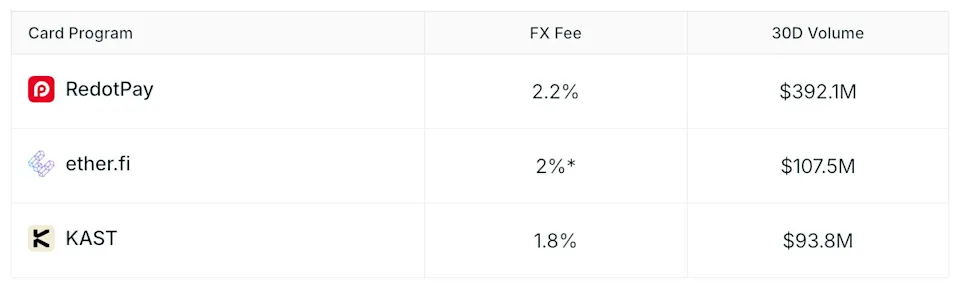
FX fees for top card programs, based on hands-on PLN testing. EtherFi offers 0% FX fees on EUR spending.
But how much of this is overhead from the payment network, versus intentional margin for the issuer or card program? To answer this, we first need to understand how fees are usually levied on card payments.
The Many Fees Behind a Card Payment
As a card user, you typically only experience one fee when you make a payment: the difference between what you paid and what you expected to pay.
For domestic payments with both stablecoin cards and traditional bank cards, transactions appear fee-free to the end user. A $5 coffee purchase in New York deducts $5 from your bank balance or 5 USDC from your neobank balance, so long as the card was issued in the US.
Behind the scenes, though, Visa and Mastercard charge a variety of fees. Broadly, they can be categorised as interchange fees and network (or "scheme") fees.
Interchange fees are paid by merchants and kept by card issuers. This revenue is the card issuers' incentive to issue cards and deal with overhead like compliance and fraud.
Interchange rates vary considerably depending on the region and the type of card:
- In the US, interchange hovers around 2% for credit cards, and is capped at $0.21 plus 0.05% for debit cards issued by larger banks (more than $10B in assets).
- In the European Union, interchange is capped at 0.3% for credit cards and 0.2% for debit cards.
Network fees are what Visa or Mastercard actually keep. The core fee both networks charge on all transactions is called an assessment fee and is approximately 0.13-0.14% for domestic transactions.
Users almost never experience network fees on domestic transactions. Instead, issuers pay them and offset them against their interchange revenue.
Cross-Border Card Fees
As soon as a transaction is made across borders, assessment fees jump substantially. Instead of a standard assessment fee, Mastercard charges something called a cross-border assessment fee while Visa charges its international service assessment.
What counts as "cross-border" is decided by geography, not currency: the network compares the country the card was issued in against the country of the merchant. A card issued in the US and used in Italy is cross-border even if it settles in euros.
What counts as "cross-border" is decided by geography, not currency: the network compares the country the card was issued in against the country of the merchant. A card issued in the US and used in Italy is cross-border even if it settles in euros.
While geography decides whether a transaction is cross-border, currency decides how much it costs. If the issuer settles in a different currency to what was actually spent, the fee climbs by as much as 0.6%:
| Fee name | Domestic (locally issued card) | Cross-border, currency match | Cross-border, currency mismatch | Premium for currency mismatch |
|---|---|---|---|---|
| Mastercard cross-border assessment | ~0.13–0.14% | ~0.6% | ~1.0% | ~0.4% |
| Visa international service assessment | ~0.13–0.14% | ~0.4% | 1.0%+ | ~0.6%+ |
This means that spending €100 in Italy with a US card incurs at least €0.40 to €0.60 in cross-border fees, and more than one euro if the card issuer settles with the network in USD.
But that's not all: an issuer settling in a foreign currency means the network has to convert between currencies. For this, Visa and Mastercard reportedly charge FX spreads anywhere between 0.1% and 0.4% — a further €0.10 to €0.40 in costs on our example transaction.
All in, settling a cross-border transaction in a foreign currency can add more than 1% in additional network fees, on top of inherent cross-border assessment fees:
| Network | Assessment premium | Network FX spread | Total premium | All-in cross-border cost |
|---|---|---|---|---|
| Mastercard | ~0.4% | 0.1–0.4% | 0.5–0.8% | 1.1–1.4% |
| Visa | ~0.6%+ | 0.1–0.4% | 0.7–1.0%+ | 1.1–1.4%+ |
In addition to these network fees, both card issuers and card programs typically apply FX fees of their own on cross-border payments, since this is one of the cleanest monetisation levers available to both of them. Ever wondered why cards offer so many travel perks?
Two Ways to Go Local
There are two ways to bring cross-border fees down at the network level, and they solve different problems.
The first is settling in the currency the user actually spent, which is called multi-currency settlement. This removes the currency-mismatch premium and the network FX spread, but the base cross-border assessment still applies because the card is still foreign.
The second is issuing the card locally. A GBP card on a UK card range used in London is a domestic transaction, and the cross-border assessment never applies at all. Among the teams we spoke to, Stripe, Wirex, and Monavate all issue across multiple jurisdictions.
In other words, local issuance makes a card cheap where users live, and multi-currency settlement makes it cheap where they travel. Ultimately, it's users' needs that decide which of these a card program can benefit from.
While stablecoins give you a global funding layer, our work with customers has shown us that there isn't one globally optimal card setup. Multi-currency settlement and local issuance are different ways to make payments behave more locally. Ultimately, designing the right approach depends on where your users live and spend, and where you plan to grow.
— Henri Stern, Head of Stripe Crypto and Cofounder and CEO of Privy
For a global card program with users spread across several continents, the answer is usually both.
Multi-Currency Settlement: The Model That Revolutionised Fintech
In the 2010s, Wise and Revolut changed the future of personal banking by making spending money across currencies dramatically cheaper. Both relied on the same basic innovation for international card payments: multi-currency settlement.
Multi-currency settlement means registering a handful of currencies with the payment network and using them to settle international transactions. This means a single card can be used across the globe, and the issuer can settle in the local currency without paying increased cross-border assessment fees or network FX spreads.
In practice, card issuers only register a handful of major currencies. For example, a card program might be configured to settle:
- EUR transactions in EUR
- GBP transactions in GBP
- USD transactions in USD
- Everything else in USD as the default settlement currency
As we saw before, this doesn’t entirely eliminate network cross-border fees, but it can reduce them by as much as 1% for settlement currencies. And if both the card issuer and program choose to apply minimal FX fees of their own, they can offer international card payments with next to zero fees for users.
Revolut and Wise have the advantage of playing the roles of both issuer and program — and of holding local card ranges across their core markets. Of course, the same idea can still apply when the issuer and program are separate entities.
Crucially, an issuer settling in multiple currencies means they take control of the currency conversion process. This means they can source liquidity where it's most favourable, and even net their own flows internally.
Going Local With Stablecoin Cards
Today, the majority of stablecoin card volume is processed by single-currency, single-region programs. At the issuer level, only a few vendors offer local issuance across multiple currencies or multi-currency settlement: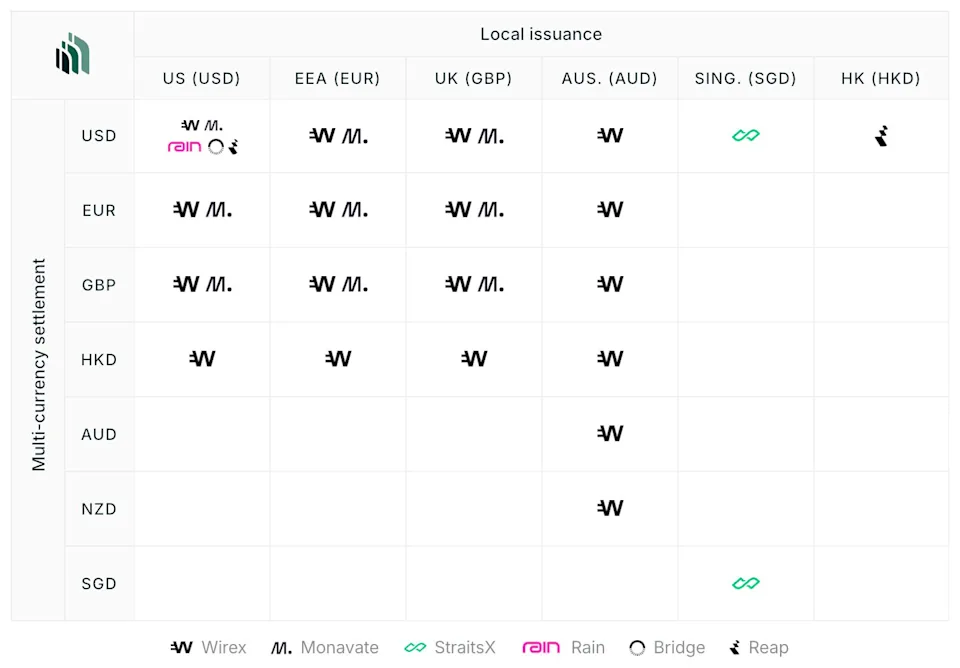
Card currencies supported by stablecoin card issuers as of September 2026.
This means that Wirex, StraitsX, and Monavate are all able to offer structurally superior FX rates to their client card programs, and in turn end users:
- For all three of these issuers, multi-currency settlement means paying abroad in the supported currencies carries less network-level overhead.
- For Wirex, four local card currencies spanning the US, Europe, and Australia mean a program can issue a card that is domestic for users in London, Frankfurt, or Sydney — the widest local footprint of any stablecoin issuer we track — with multi-currency settlement covering them when they travel.
- For Monavate, local ranges in USD, EUR, and GBP do the same job across the US and Europe.
- For StraitsX, SGD support does the same job for Singapore: local spend never leaves the domestic path, and USD settlement is reserved for spend abroad.
Onchain Settlement Across Currencies
For this article, we analysed onchain settlements for Rain and Wirex, which together account for nearly 60% of stablecoin card volume tracked on Paymentscan. Both settle with Visa onchain, and for both, USDC is the primary settlement currency.
Wirex, however, also settles with Visa in EURC, Circle's euro stablecoin. Based on onchain data, we estimate that Wirex's EURC settlements now make up approximately $500M of Visa's $20B in annualised stablecoin card settlement volume — up from zero this time last year.
Though USDC and EURC are the only currencies Visa honours for onchain settlement today, Wirex is working to bring Australian dollar and British pound settlements onchain too — and we expect the list to more than double again over the coming year.
Why Doesn't Everyone Do It?
Local issuance and multi-currency settlement are clearly major unlocks in reducing international card fees. So why doesn't everyone do it?
For some issuers, the reason is structural. Regulations or limitations of sponsor banks can prevent fiat settlement in non-USD currencies altogether. For instance, until recently Bridge issued cards through Lead Bank, a small Missouri bank which has historically not needed euro capabilities.
For others, early innovation is its own constraint. Rain began settling onchain when USDC was the only currency accepted by Visa. Adding further currencies now means reissuing an entire portfolio of cards, right down to plastic. Costs don't end at migration: each settlement currency needs its own prefunded position with the network.
Both are moving, though. Stripe, which owns Bridge, and Rain each told us that wider currency support for their stablecoin cards is on their roadmap, with more to share in the coming months.
By contrast, the issuers that have already made the investment are the ones whose users felt the cost first. In Europe, cross-border currency use was a core product problem long before stablecoins arrived. Users in non-euro countries like the UK, Switzerland, or Sweden would have to transact in EUR when vacationing across Europe or spending online, eating a 1-3% markup as they went. So it's no surprise that Revolut and Wise (as well as Wirex and Monavate!) were all built in Europe or the UK.
The same is true in markets with their own currency, where the cost lands on domestic spending rather than travel. If StraitsX issued and settled in USD, the network would treat its Singaporean users' everyday local purchases as cross-border, and the card would be paying FX on exactly the transactions it was built for:
Where [our dual-currency model] clearly pays is domestic. A domestic spend never takes a cross-border conversion at all, so the network FX leg comes out of the path entirely. That is different from getting a better rate on a conversion you still have to do. It is why we hold the SGD leg directly instead of settling everything in USD.
— Daniel Oon, VP of Ecosystem at StraitsX
The Takeaway
Stablecoin cards have gone global faster than the issuing stack beneath them. Anyone, anywhere, can hold stablecoins and spend them on a Visa or Mastercard — but most card issuers still settle with the network in USD, and international users pay for it: 1.1–1.4% in network-level costs alone, before issuers and programs layer on margin of their own.
Multi-currency settlement and local issuance don't remove every cross-border fee, but they strip out the part that's avoidable. For a program, that 1%+ is either a competitive edge or an economic one: lower fees for users, or healthier unit economics for the business.
EURC has gone from near zero to $500M in annualised stablecoin card settlements a year, and Visa's onchain currency list is getting longer. We expect non-USD stablecoins to be one of the next major unlocks not just for cards, but for crypto more broadly.
Acknowledgements
Thank you to Pavel Matveev and Dan Rowlands at Wirex; Henri Stern, Max Segall, and Debbie Soon at Stripe; Daniel Oon at StraitsX; Kevin Wood at Exodus (Monavate); Ari Eiberman at Gnosis Pay; and Charles Yoo-Naut at Rain for the context that made this article possible.