

A crypto card sold as "no KYC" makes a promise that the rest of its issuing chain is not allowed to keep. Every Visa or Mastercard card runs on a BIN licensed to a member institution that has its own anti-money-laundering duties. When that institution or the network acts, the cardholder is left with a frozen or deleted card.
The record so far bears this out. Published reporting since June 2025 documents at least four no-KYC card services whose cards stopped working: SolCard, PayWithUs, UnCash, and CinCin. In two of those cases, companies in the card's issuing chain said cards had been diverted. Rain said a user who had passed KYC resold a card through UnCash, and Bluebanc said CinCin's cards appeared to have been obtained through a third party and redistributed. Of the providers still selling cards as no-KYC, CasherCard and Kripicard name no issuer on their sites, and some contradict their headline claim further down the same site.
Paymentscan's own testing shows the same thing from the other side: all 42 cards in our test documents required an identity check. Paymentscan did not open accounts on cards sold as no-KYC, so their claims are read from their own pages and from published reporting, not tested.
"No KYC" Usually Describes One Step
Identity checks happen at several points in a card's life, and a provider can skip one while the card still depends on another. Paymentscan's 42 test documents record four kinds of check, grouped by what triggers them. No document records when the check happens relative to issuing the card, so the table does not claim an order.
| Trigger | What is checked | Where Paymentscan recorded it |
|---|---|---|
| TriggerCard sign-up | What is checkedName, date of birth, address, government ID, facial video | Where Paymentscan recorded it38 of 42 documents list these five items. The Revolut, Bybit, and Wirex One documents name who runs the check without the list, and the Send.it document names vendors only |
| TriggerBank or fiat rails | What is checkedA second identity or proof-of-address check for fiat deposits, bank accounts, or transfers | Where Paymentscan recorded itPlasma One, Exa, Send.it, Rizon, Hyperbeat, Kosh, RedotPay |
| TriggerProof of address | What is checkedAn address document, supplied through Jumio | Where Paymentscan recorded itCoinbase, Crypto.com |
| TriggerSpending threshold | What is checkedProof of address before spending above a set amount | Where Paymentscan recorded itBybit, above €150 on the virtual card |
Thirty-five of the 42 documents name a third-party identity vendor: Sumsub in 24, Persona in seven, Onfido in three, and Veriff in one. The other seven record in-house or hosted checks, another vendor entry, or no vendor disclosed. Every one records a check.
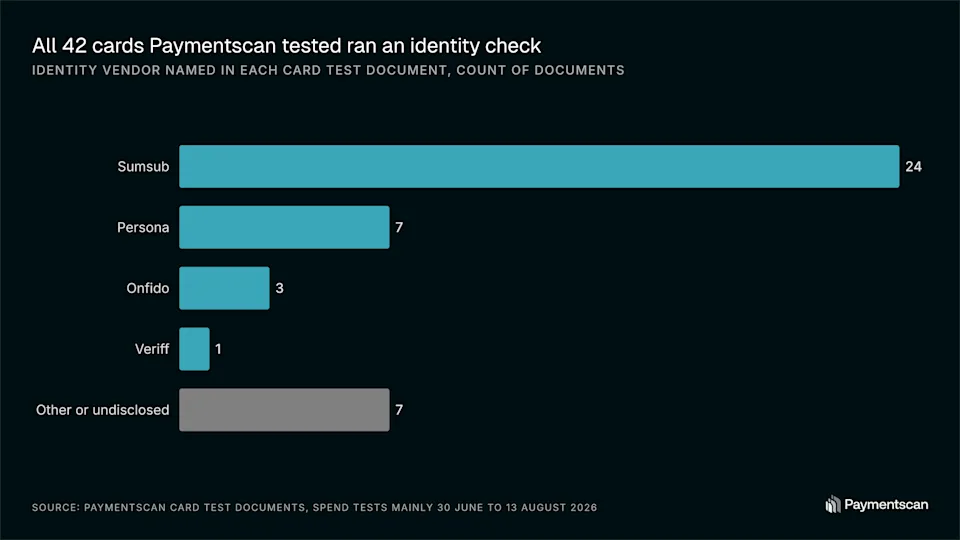
Identity vendor named in each of 42 Paymentscan card test documents. Other or undisclosed: in-house or hosted checks at OKX, Revolut, and Wirex, a likely in-house check at Deblock, SafePal's "ReadID Ready" entry, and no vendor disclosed at KardPay and based. Spend tests dated mainly 30 June to 13 August 2026.
A card sold as no-KYC is therefore making a claim about one moment, usually sign-up. That says nothing about what happens when the cardholder wants a bank transfer, a higher limit, or a card that keeps working after the issuer reviews the program.
What the Providers' Own Pages Say
We read these providers' pages on 19 November 2026 and rechecked them on 24 November 2026. Paymentscan has not tested these cards.
| Provider | The claim | What the same site also says |
|---|---|---|
| ProviderCasherCard | The claimSign-up "with email, no phone, no personal data required"; a sample card names the holder "Anonymous"; limits of $5,000 per transaction and $500,000 per month; $4 per card and a 5% top-up fee | What the same site also saysNames no issuer or BIN sponsor. The footer says card issuing is provided by "regulated third-party providers and authorized Visa/Mastercard partners" without naming any. The terms, last updated 6 June 2026, do not mention KYC |
| ProviderKripicard | The claimSign-up with an email address and password; "No paperwork, no waiting" and "No bank account, no credit check" | What the same site also saysA compliance section on the same page lists "Identity verification, sanctions screening, and AML/CFT monitoring with regulated partners" and KYC/KYB. The footer says cards are issued by "licensed partners" without naming them |
| ProviderBingCard | The claimFast online sign-up and no credit checks | What the same site also saysThe same page tells physical-card buyers to "Complete your KYC process online", states that all clients are expected to complete KYC, and describes BingCard as an intermediary between card-issuing companies |
| ProviderSpendNode | The claimA listings page titled "Best No KYC Crypto Cards 2026" | What the same site also saysIts text says it rejects zero-KYC listings and that the cards it lists are not technically no KYC. Its top five are KAST, Jupiter Global, COCA, MetaMask, and Bleap, and the Paymentscan test documents for KAST, COCA, MetaMask, and Bleap record identity verification |
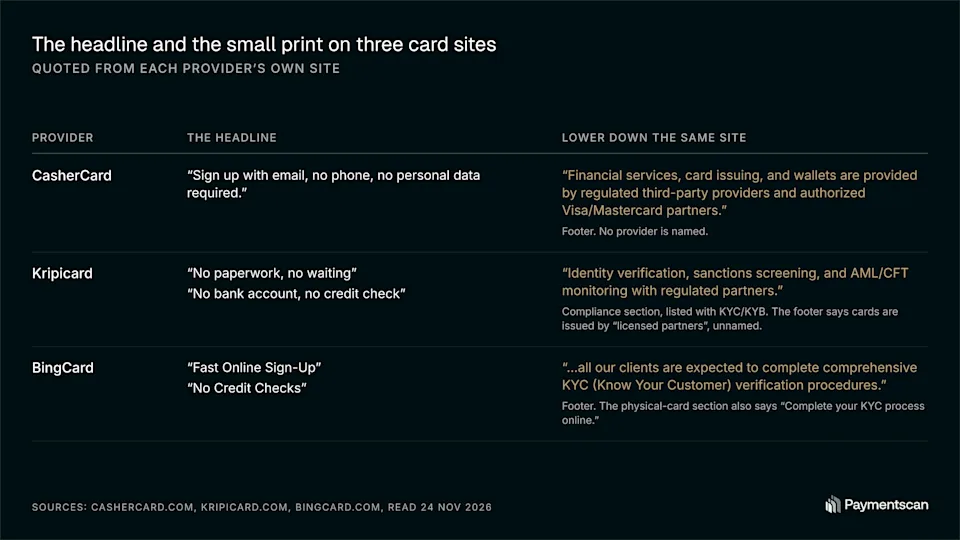
Headline claims on the CasherCard, Kripicard, and BingCard sites, set against what the same sites say lower down. Quoted from cashercard.com, kripicard.com, and bingcard.com, read 24 November 2026.
Two patterns repeat. The headline claim is qualified or contradicted lower down the same site, and the institution that issues the card appears only as an unnamed "partner". A CasherCard or Kripicard cardholder whose balance is frozen cannot tell from either site which regulated institution runs the card program, and so has no named party to take a complaint to.
The Card Runs on Someone Else's Licence
A card number sits on a BIN, a range licensed to a member institution that carries the network-facing obligations. The seller can skip a check, but the BIN sponsor still carries the obligation. Paymentscan's guide to BIN sponsorship explains how programs share or hold those ranges.
Crystal Intelligence, which registered accounts on the platforms it tested, counted almost one hundred crypto card providers in April 2026 and approximately 250 by September. In April it found that 67.7% offered no KYC or low-friction verification. It linked 54 BIN records to more than 35 providers, with issuers in nine countries. Of those records, 32 (59%) operated without KYC at the point of card issuance, covering 22 unique BINs, and a single BIN served seven providers. Crystal's own finding is that BIN sponsors retain responsibility for KYC and AML.
That concentration is a risk the cardholder cannot see. If the sponsor behind a shared BIN acts, every provider on that BIN is exposed at once, and none of the provider pages above names the sponsor.
The reported cases also show where some of these cards come from. Rain told Fintech Business Weekly that UnCash was never an authorised Rain program, and that a user who had completed KYC obtained a card and resold it through the UnCash site. Bluebanc said CinCin's cards appeared to have been illicitly obtained through a third party and redistributed through unauthorised channels. On those accounts, the buyer did not hold an anonymous product. The buyer held a card obtained from someone else, and it worked only until the issuing side found it.
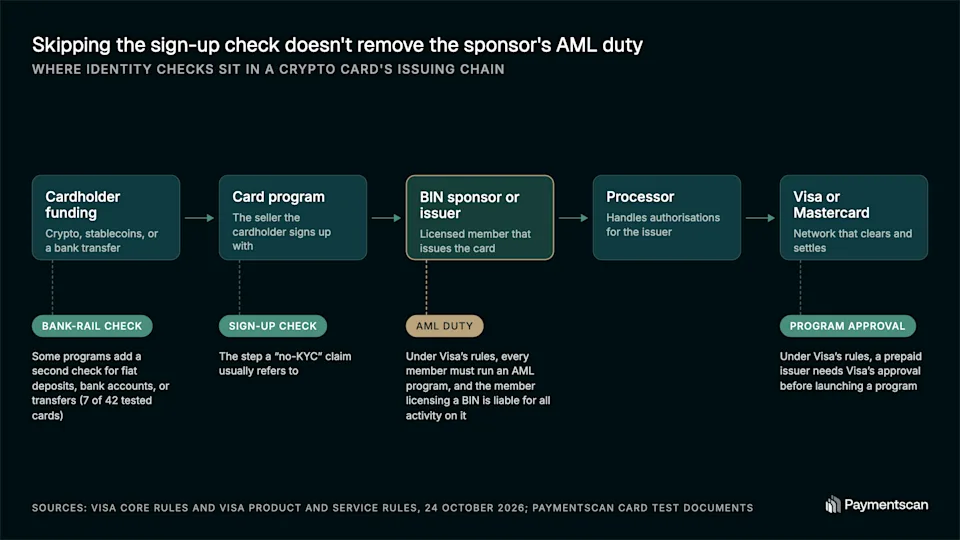
Where identity checks sit in a crypto card's issuing chain. A seller of no-KYC cards can skip the sign-up check, but the BIN sponsor's AML duty and Visa's prepaid program approval still apply. Sources: Visa Core Rules and Visa Product and Service Rules, 24 October 2026; Paymentscan card test documents.
For how a legitimate program is structured end to end, see Paymentscan's guide to launching a stablecoin card program.
How No-KYC Card Programs Have Ended
The four cases below come from published reporting, not Paymentscan testing. They differ in what ended and in how well the cause is established, so the table keeps those two things apart.
| Case | When | What stopped | What the reporting says about cause |
|---|---|---|---|
| CaseSolCard | WhenJune 2025 | What stoppedSome unverified users lost access to their virtual Visa cards. In a 26 June X post, SolCard told users with cancelled or frozen cards that they could request their funds | What the reporting says about causeThe Defiant reports a company representative saying a no-KYC option would be reinstated. The article does not confirm that it was. The issuer is not named |
| CasePayWithUs | WhenOctober 2025 | What stoppedAfter Fintech Business Weekly began making inquiries, all of the BINs PayWithUs offered appeared to have been shut down, and previously used cards showed as "deleted" | What the reporting says about causePeople who appeared to represent PayWithUs had marketed it on forums as no-KYC since February 2024, and its October 2025 FAQs said it did not require KYC. A support representative then said that, due to new regulatory requirements, all users were required to complete KYC. Sutton said it took prompt internal action. As of early February 2026 the service was still offering cards, and the newsletter found the new KYC step easily circumvented (Fintech Business Weekly, 8 February 2026) |
| CaseUnCash | WhenFebruary 2026 | What stoppedThe service shut down after the newsletter's 8 February reporting, and a notice told users that remaining balances could be withdrawn to external crypto wallets | What the reporting says about causeThe notice blamed Mastercard, saying it had decided UnCash's card issuers must be shut down (note by Jason Mikula). The attribution is UnCash's own, and Paymentscan found no confirmation from Mastercard. Rain said UnCash was never an authorised Rain program |
| CaseCinCin | WhenMarch 2026 | What stoppedOne CinCin card issued through Sutton stopped working after the reporter's inquiries to Sutton and Bluebanc | What the reporting says about causeSutton said it has no tolerance for any variant of no-KYC programs. Bluebanc said it had no relationship with CinCin and that the cards appeared to have been illicitly obtained through a third party. Mastercard did not respond (Fintech Business Weekly, 22 March 2026). The report documents one card, not the end of the service |
Three of the four stoppages followed press reporting or a reporter's inquiries: PayWithUs, UnCash, and CinCin. In three cases the cards stopped first and holders were then pointed elsewhere: SolCard users to a funds request, PayWithUs users to a KYC step, and UnCash users to a withdrawal. PayWithUs shows that a stoppage does not end the practice either: four months later it was still offering cards, behind a KYC step the reporter found easy to get around.
The sample is the reporting Paymentscan found, so it shows how these programs end, not how often. SpendNode gives the same reason for refusing zero-KYC listings: such products can impose checks retroactively, freeze a balance, or disappear when the issuing partner intervenes.
Before Putting Money on a Card Sold as No-KYC
- Find the named issuer and BIN sponsor. If the terms name neither, no regulated party is visible to hold to account when the card stops. Paymentscan's issuer pages cover scheme membership, BIN sponsorship, and programs.
- Ask which step the claim covers. Sign-up, card issuing, first load, a spending threshold, and bank rails are separate checks. Seven of the ten second checks in Paymentscan's test documents attach to bank or fiat rails.
- Compare the advertised limits with the legal thresholds. A limit far above €150, £150, or the $1,000 US prepaid-program threshold cannot rest on a low-value exemption.
- Read what the terms say about suspension and refunds. In three of the four cases above, users were left with a withdrawal, a funds request, or a KYC step after the card stopped.
- Load only what you can afford to lose access to. The cardholder, not the seller, bears the loss of a frozen balance.
Conclusion
A no-KYC crypto card is a card whose seller has skipped a check that its issuer is still obliged to make. The reported cases show how that ends: the sponsor or the network acts, often after someone asks questions, and the cards stop. The cardholders were the ones left asking for their money back.
The evidence does not prove that no card works without identity checks today. It shows that any such card depends on an issuer that has not yet acted, and that the providers selling these cards do not name that issuer.