

Wirex-powered cards processed $239.9 million in October, more than double March’s volume. Monthly active addresses rose faster, from 35,673 to 87,395.
Wirex’s infrastructure is being integrated into products that already have users, balances, and payment activity.
COCA embeds Wirex card and banking infrastructure inside a self-custodial wallet. Kolo uses Wirex for cards, named accounts, and payment rails within a product that also works with another issuer. BingX connects its existing exchange balance to a Wirex-powered card.
Cards are front and center, but the same underlying balances can be funded through pay-ins, converted through onchain FX, sent abroad through payouts, or used by Earn, Borrow, and agent-driven payment products.
Inside Wirex’s Modular Stack
The Wirex platform includes self-custodial wallets, card issuance, named accounts, stablecoin conversion, and payment rails.
Wirex is also a principal member of Visa and Mastercard, giving it direct access to both card schemes for issuing and settlement.
Partners use that stack in different configurations rather than launching the same standardised product. Card infrastructure inside a wallet, accounts and cards within a broader financial product, or card payments connected to an existing balance system.
COCA: Card and Banking Rails
COCA provides the clearest program-level example of Wirex’s card growth. Its card and banking rails use Wirex infrastructure, while COCA retains control over the user experience.
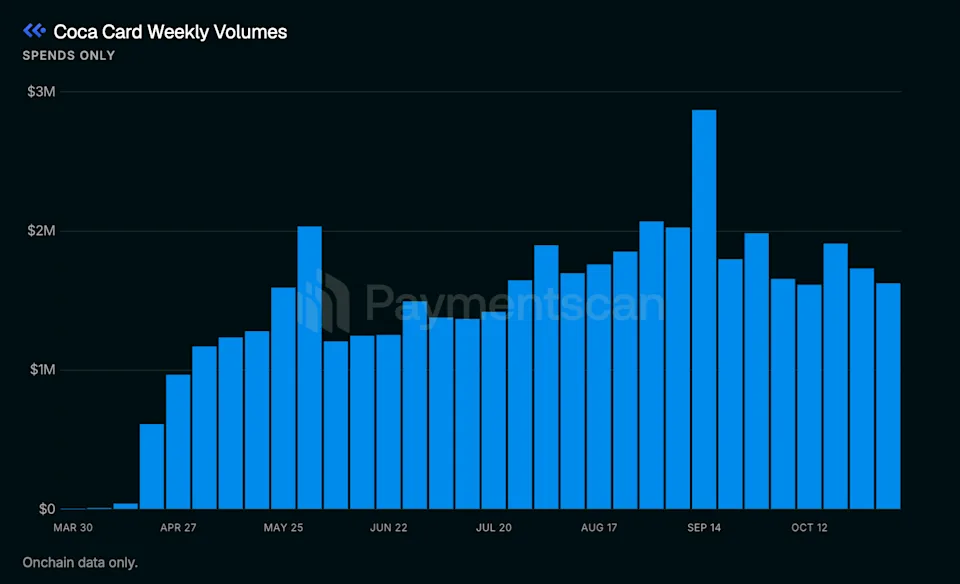
We recorded $1.17 million of COCA card spend in April and $7.82 million in October. Active addresses increased from 1,826 to 12,199 over the same period, while monthly spend per active address remained almost unchanged at about $641.
Kolo: Adding Accounts and Local Rails
Kolo shows how Wirex can add accounts and local rails to a product that already has a card program. Wirex provides accounts in EUR, GBP, USD, and other currencies, plus local payment rails that were not previously available.
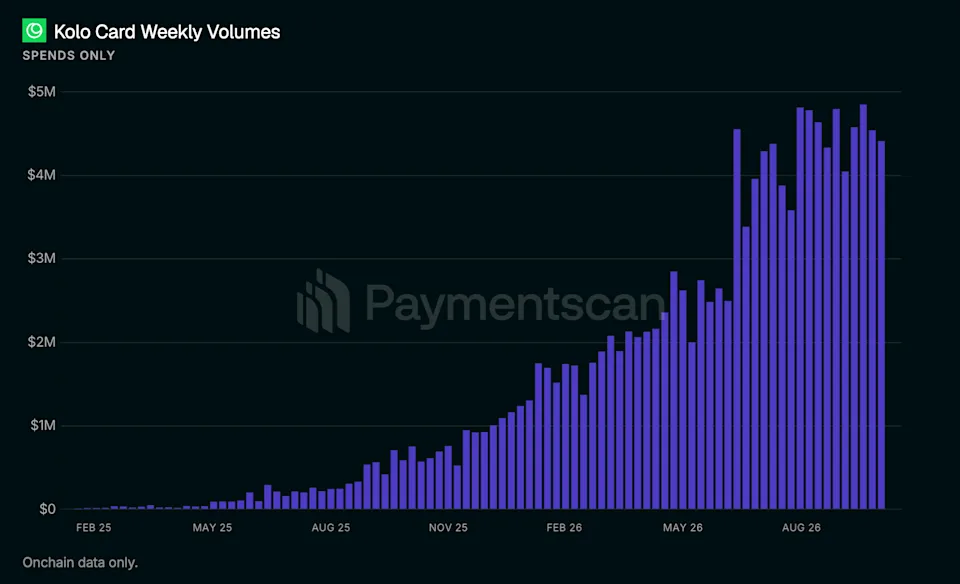
These services let Kolo users receive income and pay bills without replacing its existing card program. Paymentscan tracked $20.5 million of Kolo card spend in October, approximately $4.2 million of which was attributable to Wirex.
BingX: Attaching a Card to an Existing Balance
BingX shows how Wirex can connect a card to an existing balance system. The exchange reports more than 40 million users and launched its Wirex-powered Visa card in July before expanding availability to eligible users in supported regions in September.
Card payments draw USDT directly from the user’s BingX Funding Account, without a separate card balance. This removes the need to preload the card and places it inside an account users already hold.
Paymentscan does not yet track this program. BingX's user base therefore represents potential reach, not demonstrated card adoption, and we’re waiting to see how much of that existing audience becomes active card users.
Beyond Cards: Rails, Capital, and Agents
Cards are one output of the underlying account and balance infrastructure.
Wirex’s Rails APIs let partners receive payins, convert assets through onchain FX, and send bank, card, or crypto payouts. The balance behind a card can support inbound funding and outbound transfers rather than treating card issuing as a standalone product.
Capital changes how those balances can be used through Earn and collateralised Borrow products.
Agents sits above those products as an access and execution layer rather than another payment rail. Wirex’s pre-built skills and Model Context Protocol integration provide account data, documentation, and APIs to AI agents.
Transactions remain subject to existing permissions and authorisation controls; Signature mode requires a wallet-signed instruction before funds move.
Partners Pick the Chain
Wirex is moving towards a model in which partners select the chain beneath the product. Tempo and Arc have recently been added as onchain settlement options, with Stellar and Tron also available. Solana is the next planned native deployment, per Wirex.
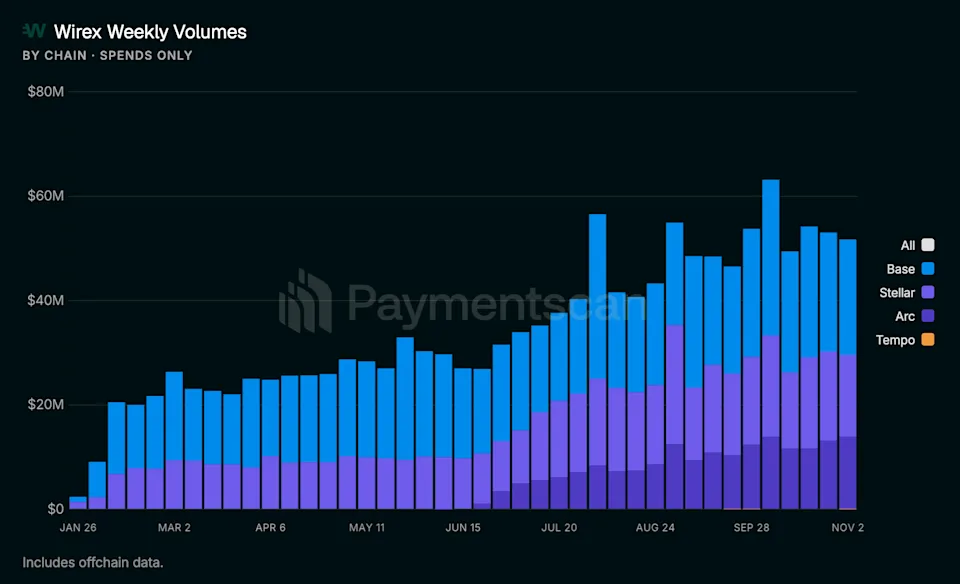
Each chain can serve beneath the entire Wirex stack: cards, accounts, and broader payment products. Partners can align the stablecoin settlement layer with their assets and product design rather than inherit the constraints of a single chain.
Paymentscan tracked $483.0 million in cumulative Wirex card settlement volume on Stellar through October, compared with $164.5 million on Arc. Wirex One accounted for $164.2 million, or 99.8%, of the Arc total.
What the Three Models Have in Common
Wirex’s model is to fit cards, accounts, rails, and settlement into products with existing users and balances. COCA, Kolo, and BingX show three integration paths; Rails, Capital, and Agents extend the same balance infrastructure beyond card spend.
The clearest comparable usage signal remains card volume. The next test is how much partner distribution translates into attributable, recurring activity across the rest of the stack.
- Build on Wirex
- Explore Wirex metrics
Disclaimer: Wirex sponsors Paymentscan’s platform and research. This article draws on public announcements and information provided directly to Paymentscan by Wirex. Paymentscan retained full editorial control.