

Two Visa Signature cards from different US banks can carry different protections, and both are correctly labelled. One can include trip-delay cover and an extended warranty while the other includes neither. The tier printed on a Visa card fixes a short list of protections that Visa builds into every card at that level. It also offers a longer list that the issuer decides whether to include.
Visa sells three consumer credit tiers in the US: Visa Traditional, Visa Signature, and Visa Infinite. Each step up moves more protections into the built-in list. Rewards, annual fees, credit limits, interest rates, and foreign transaction fees are not part of any Visa tier. The issuer sets them in its own cardholder terms, and a card program can add a further layer of its own on top.
The difference matters for anyone comparing stablecoin cards. Visa carried $9.83 billion of the $10.21 billion in Paymentscan-tracked card spend between November 2025 and October 2026, approximately 96%, and some stablecoin card programs now sell a higher Visa tier as part of a paid plan.
Who Decides What a Visa Card Includes
Visa does not issue cards. A bank or another licensed issuer does, and the issuer decides which Visa product each card is issued as. The product decides which Visa benefits apply, and Visa tells cardholders to get the complete terms from their issuer's Guide to Benefits.
That leaves three parties shaping one card. Visa defines what each tier includes and what it makes optional. The issuer chooses from the optional list and sets the fees, rewards, and credit terms. A card program built on the issuer, such as a co-branded or fintech card, can then tie the tier itself to a membership plan, a deposit, or a token stake.
Outside the US, Visa uses other names in some markets. Its Canadian site, for example, lists Visa Classic, Gold, and Platinum alongside Visa Infinite, with a benefits list of its own. This article covers the three US consumer credit tiers.
What Visa Builds Into Each US Tier
Visa's US pages for Visa Traditional, Visa Signature, and Visa Infinite list each tier's benefits in two groups: benefits listed without a mark, and benefits marked as "issuer optional". The table below follows that split.
| Benefit | Traditional | Signature | Infinite |
|---|---|---|---|
| BenefitZero Liability, lost or stolen card reporting, emergency card replacement, emergency cash, Cardholder Inquiry Service, Roadside Dispatch (pay-per-use) | TraditionalBuilt in | SignatureBuilt in | InfiniteBuilt in |
| BenefitTravel Emergency Assistance Services | TraditionalNot listed | SignatureBuilt in | InfiniteBuilt in |
| BenefitAuto Rental Collision Damage Waiver | TraditionalNot listed | SignatureIssuer optional | InfiniteBuilt in |
| BenefitExtended Warranty Protection | TraditionalNot listed | SignatureIssuer optional | InfiniteBuilt in |
| BenefitPurchase Security (90 days) | TraditionalNot listed | SignatureIssuer optional | InfiniteBuilt in |
| BenefitReturn Protection | TraditionalNot listed | SignatureIssuer optional | InfiniteBuilt in |
| BenefitTravel Accident Insurance | TraditionalNot listed | SignatureIssuer optional | InfiniteBuilt in |
| BenefitTrip Cancellation or Interruption | TraditionalNot listed | SignatureIssuer optional | InfiniteBuilt in |
| BenefitLost Luggage Reimbursement | TraditionalNot listed | SignatureIssuer optional | InfiniteBuilt in |
| BenefitTrip Delay Reimbursement | TraditionalNot listed | SignatureIssuer optional: up to $300 for delays over 12 hours | InfiniteBuilt in: up to $500 for delays over 6 hours |
| BenefitPrice protection, cellphone protection, hotel theft, baggage delay, emergency medical and dental, emergency evacuation | TraditionalNot listed | SignatureIssuer optional | InfiniteIssuer optional |
| BenefitGlobal Entry statement credit ($120) | TraditionalNot listed | SignatureIssuer optional | InfiniteNot listed |
Visa Traditional carries account-security and emergency services, and no purchase or travel insurance. Visa Signature adds travel emergency assistance as standard and lists 15 further benefits as issuer optional. Visa Infinite moves eight of those 15 into the built-in list, including rental-car cover, extended warranty, and trip cancellation. Its trip-delay benefit also pays more, and sooner.
Several services are the same at every tier. Roadside Dispatch is pay-per-use: Visa sends a tow operator or locksmith, and the cardholder pays a set price for each service call. The Zero Liability policy covers unauthorised transactions on all three tiers, but Visa excludes certain commercial card and anonymous prepaid transactions, and transactions not processed by Visa.
A benefit Visa builds in still has conditions. Visa's pages make purchase and travel cover depend on paying with the covered card, and the issuer's Guide to Benefits sets the claim limits, exclusions, and filing steps.
What the Tier Leaves to the Issuer and the Card Program
Visa's tier pages describe protections and services. They do not set the annual fee, the rewards or cashback rate, the credit limit, the interest rate, or the foreign transaction fee. Two Visa Infinite cards can charge very different annual fees and earn different rewards while sharing the same built-in protections.
A card's final package comes from four layers, each depending on the one before it:
- The Visa product. It fixes the built-in benefits and the menu of optional ones.
- The issuer. It picks from the optional menu, sets fees, rewards, and credit terms, and publishes the Guide to Benefits that governs cover.
- The card program or membership tier. A program can decide which Visa product a customer receives, and add perks such as cashback, yield, or partner offers that Visa has no part in.
- The eligibility conditions. Paying with the covered card, claim caps, residency, and exclusions decide whether a listed benefit pays out in a given case.
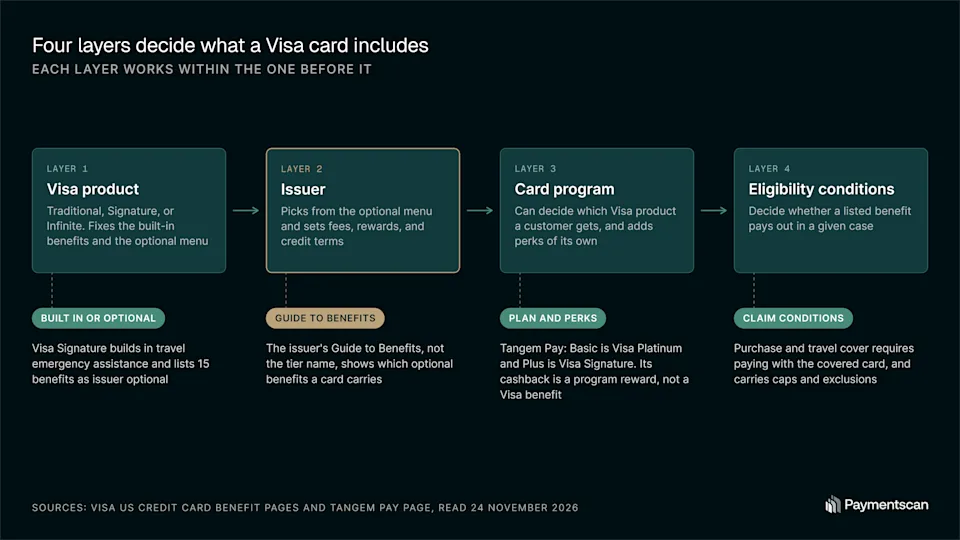
Sources: Visa's US credit card benefit pages and Tangem's Tangem Pay page, read on 24 November 2026.
The issuer-optional list is where most confusion starts. A Visa Signature card is not guaranteed rental-car cover, extended warranty, purchase security, or trip-delay cover. Each one is present only if the issuer included it, which is why the Guide to Benefits, not the tier name, is the document to check.
Why Issuers Care Which Tier a Card Carries
On US credit cards, the tier also changes what the issuer earns. The Visa USA interchange schedule effective 24 October 2026 sets separate consumer credit rates for Visa Infinite (split into spend qualified and not spend qualified), Visa Signature Preferred, Visa Signature, Traditional Rewards, and all other products. For a card-present purchase at a retailer in Performance Threshold I, the band Visa reserves for its largest retailers by transaction count and Visa volume, the rates are:
| Visa product | Interchange rate |
|---|---|
| Visa productVisa Infinite, spend qualified | Interchange rate2.30% + $0.10 |
| Visa productVisa Infinite, not spend qualified | Interchange rate1.90% + $0.10 |
| Visa productVisa Signature Preferred | Interchange rate2.10% + $0.10 |
| Visa productVisa Signature | Interchange rate1.65% + $0.10 |
| Visa productTraditional Rewards | Interchange rate1.43% + $0.10 |
| Visa productAll other products | Interchange rate1.43% + $0.10 |
The Infinite, Signature Preferred, and Signature rates are the same in all three retail thresholds. Only the Traditional Rewards and all-other rates rise for smaller retailers, to 1.47% and then 1.51%.
Visa describes interchange as a transfer between financial institutions. The merchant pays its own bank a merchant discount, and the issuer receives the interchange. On these rates, a Visa Infinite spend-qualified purchase earns the issuer 0.87 percentage points more than the same purchase on a Traditional Rewards card. That gap is one source of the money that premium protections and rewards are paid from.
The same schedule has no tier columns for US-issued consumer debit or prepaid cards. A consumer debit or prepaid purchase is priced by whether the issuer is regulated or exempt under the US debit interchange cap. On a card-present retail purchase, a regulated issuer receives 0.05% + $0.21, while an exempt issuer receives 0.80% + $0.15 on debit and 1.15% + $0.15 on prepaid. Regulated issuers that certify to Visa's fraud-prevention standards receive another $0.01. A Signature or Infinite label on a US debit or prepaid card does not change the interchange.
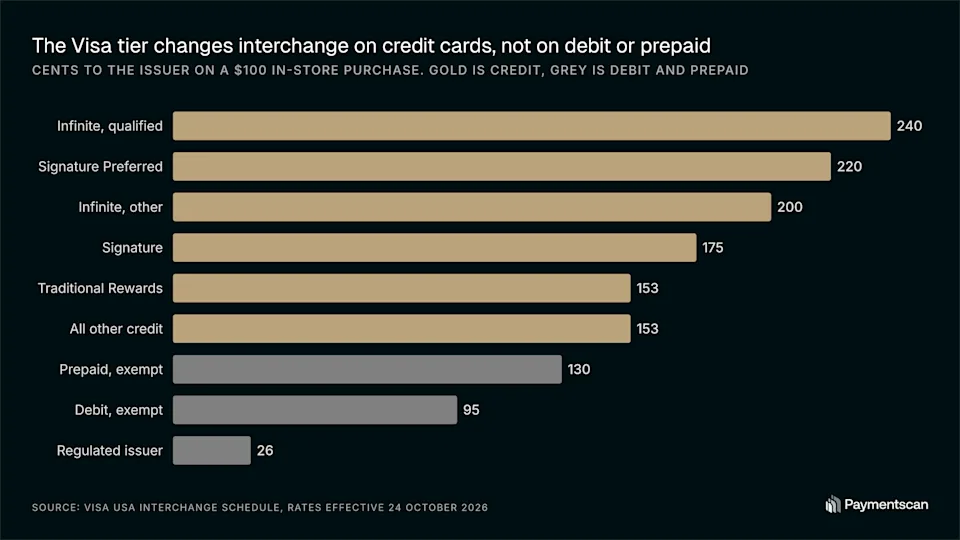
Interchange on a $100 card-present purchase. Credit rates are Retail Credit, Performance Threshold I; debit and prepaid rates are CPS/Retail, the same for every tier. Regulated issuers that certify to Visa's fraud-prevention standards receive 1 cent more. Source: Visa USA Interchange Reimbursement Fees, rates effective 24 October 2026.
Visa Tiers on Stablecoin Cards
Stablecoin card programs show the layers most clearly, because the program often decides which Visa product a customer gets. Tangem Pay, issued by Rain, ties the Visa tier to its plan. The Basic card is Visa Platinum, the Plus card is Visa Signature, and a Prestige plan listed as coming soon is Visa Infinite. The card spends only the balance loaded on it.
Tangem's comparison table marks extended warranty, price protection, and purchase protection as included on Plus and not on Basic. Price protection is issuer optional on Visa Signature, so its presence on Plus is a choice made by the program and its issuer, not a feature of every Signature card. Visa Platinum is not one of the three tiers on Visa's US consumer credit pages, and Tangem's page does not state where the card is issued, so the Basic card's benefits have to be read from its cardholder terms.
Business cards sit on a separate product line. Altitude, a business account from Squads, issues a virtual Visa Signature Corporate card that spends from funds added to the card balance, with no credit line. Altitude lists purchase protection and extended warranty of up to $10,000 each and price protection of up to $2,000. Those are commercial-card benefits, and they should not be compared with a consumer Visa Signature card as though the two were the same tier.
Program rewards sit outside the Visa tier entirely. Paymentscan tracks cashback paid by programs such as EtherFi and Gnosis Pay. That cashback is a program reward, funded and governed by the program's own terms, and it can change without any change to the card's Visa product.
How to Check What a Specific Card Includes
- Identify the exact Visa product. Check whether the card is consumer or business, and credit, debit, or prepaid. The cardholder agreement names the product.
- Get the issuer's current Guide to Benefits. Visa's pages refer cardholders to it for complete terms.
- Check each issuer-optional benefit by name. On a Visa Signature card, confirm rental-car cover, extended warranty, purchase security, and trip-delay cover one at a time.
- Separate program perks from Visa benefits. Cashback, yield, membership tiers, and token-stake requirements are governed by the program's terms, not by Visa.
- Read the conditions before relying on cover. Most purchase and travel benefits require the purchase to be paid with the covered card and carry caps and exclusions.
Conclusion
In the US, Visa Traditional, Visa Signature, and Visa Infinite define a floor of protections and a menu of optional ones. Infinite builds in most of what Signature leaves optional, and on credit cards each tier carries its own interchange rate. Visa does not set the fees, rewards, or credit terms, and an issuer can leave much of the Signature menu out.
For a stablecoin card, the tier answers one question: which Visa protections the card can carry. Whether it does carry them depends on the issuer's Guide to Benefits, and whether the cardholder gets that tier at all can depend on the program's plan.
*Data note: Paymentscan figures are card spend by payment network for the 12 calendar months from November 2025 to October 2026, including onchain flows and partner-reported feeds, as shown on paymentscan.xyz/payment-networks. They cover the programs Paymentscan tracks, not Visa's total volume.